
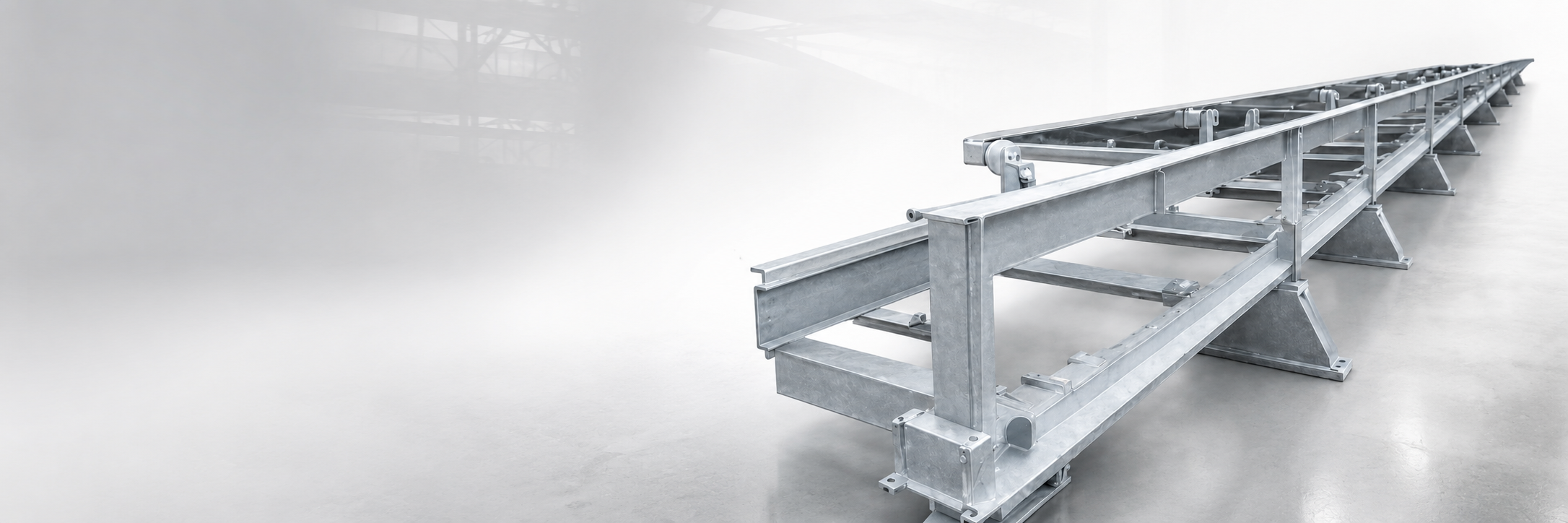
Frames and Supports

Frames and Supports
Structural support systems designed to maintain conveyor alignment, rigidity, and long-term mechanical stability.
| Parameter | Available Options / Range | Remarks |
|---|---|---|
| Product Group | Stringers, Supports & trestles, Adjustable frames | Modular construction |
| Conveyor Length Compatibility | Short / Medium / Long conveyors | Layout dependent |
| Frame Type | Fixed frame / Adjustable frame | Alignment & installation tolerance |
| Stringer Profile | C-channel / U-channel / Box section | Load & span dependent |
| Support Spacing | According to conveyor design | Based on load distribution |
| Height Adjustment | Fixed / Adjustable | Installation & maintenance |
| Material | Carbon steel | Standard structural grades |
| Surface Protection | Painted / Galvanized (optional) | Outdoor & corrosive environments |
| Mounting Method | Anchored to concrete / Free-standing | Site conditions |
| Compatibility | Rollers, idlers, impact beds | System-integrated design |
| Operating Environment | Indoor / Outdoor | Weather exposure |
| Duty Class | Light / Medium / Heavy duty | Based on load & runtime |
| Design Standards | DIN / ISO compatible | Customer standards possible |
About Frames and Supports
Conveyor stringers form the longitudinal backbone of the belt conveyor structure. They carry the idler frames, transfer loads to the support trestles, and maintain the correct geometry of the conveyor profile along its full length. Stringer profile selection — C-channel, U-channel, or box section — is determined by the conveyor span, load distribution, and any dynamic forces from the belt and material.
Support trestles and frames transfer the combined load of the structure, belt, and material to the foundation. Spacing between supports is set by the allowable deflection of the stringer under full load — typically limited to L/500 to L/800 of the span. Closer support spacing reduces structural steel weight but increases foundation requirements and civil costs.
Adjustable frames allow for height and lateral position correction during installation and commissioning. This is particularly important on long conveyors where civil work tolerances accumulate, or on conveyors with significant elevation changes requiring precise grade alignment.
Surface protection is specified based on the operating environment. Painted finishes suit standard indoor applications. Hot-dip galvanising provides long-term corrosion resistance for outdoor, coastal, or chemically aggressive environments. Stainless steel frames are available for food-grade or extreme corrosion applications.
Frequently Asked Questions
Support spacing is governed by the allowable deflection of the stringer under full load — typically L/500 to L/800 of the span, where L is the distance between supports. Heavier material loads and wider belts require closer support spacing or heavier stringer profiles to stay within deflection limits.
C-channel stringers are the standard choice for light to medium-duty conveyors with short to medium spans. U-channel and box section profiles are used for longer spans or heavier loads where greater section modulus is required to control deflection and stress. Box sections also provide better torsional stiffness for conveyors with significant horizontal curves.
Adjustable frames are recommended when installation tolerances are tight, when the conveyor must be aligned to existing equipment, or on long conveyors where cumulative civil work tolerances make precise fixed-frame positioning impractical. They are also used when future re-alignment may be required due to settlement or operational changes.
Painted frames use a primed and topcoated finish suitable for standard indoor environments. Hot-dip galvanising provides a metallurgically bonded zinc coating that offers 20–40 years of corrosion protection in outdoor or coastal conditions. Galvanised frames cost more upfront but significantly reduce maintenance costs over the conveyor’s operating life.
Yes. Frames and supports are designed to accommodate conveyor inclinations and horizontal curves. Inclined conveyors require modified trestle designs to maintain vertical support geometry. Horizontally curved conveyors require specially designed idler frames and stringers to maintain the correct belt tracking radius.
Moventis frames and supports are dimensioned to accommodate standard carrying idler frames, return idlers, impact beds, and belt cleaner mounting points. Custom frame designs are available for non-standard idler geometries or third-party equipment integration.