
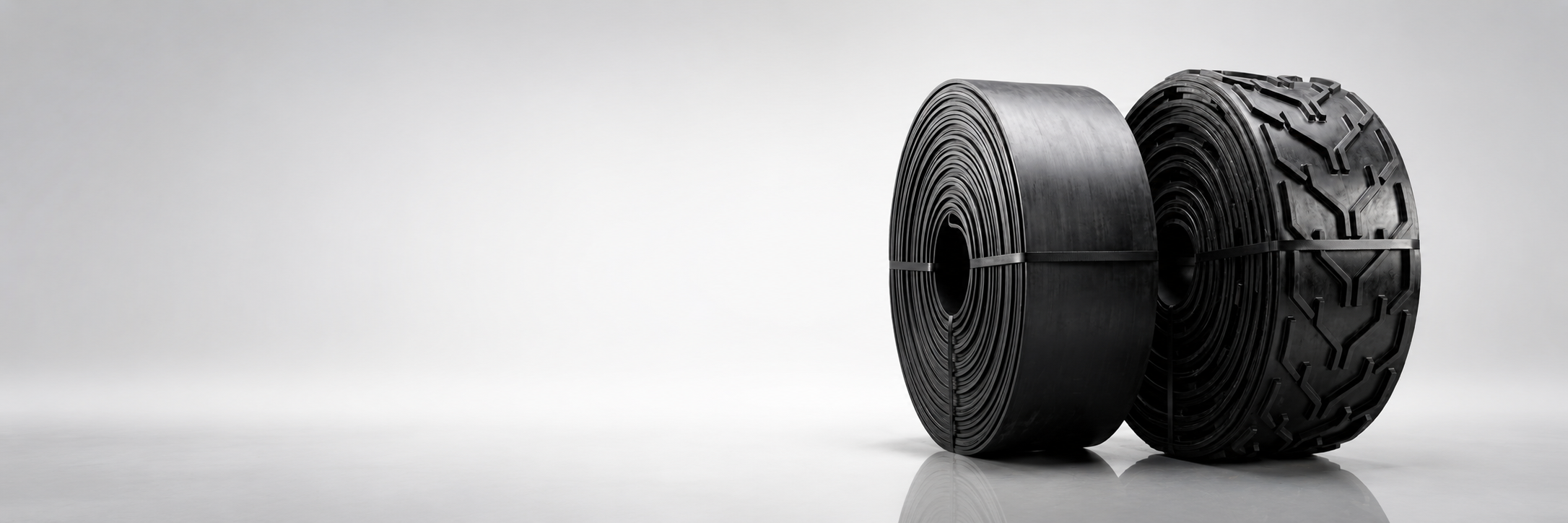
Conveyor Belts

Conveyor Belt
Our solutions are focused on achieving the right balance between performance, durability, and cost efficiency, while ensuring full compatibility with the overall conveyor system.
Interactive Belt Selector
Find the perfect conveyor belt for your application
MOVENTIS – EP FLAT CONVEYOR BELTS
| Application | Resistance | EP Plies | Cover (T/B) | EP (Tensile) | Elongation | Temperature |
|---|---|---|---|---|---|---|
| Sand, gravel | Abrasion | 2–4 | 3+1.5 / 4+2 | 100–160 | ≤18% | -20 / +80 |
| High wear zones | High abrasion | 3–4 | 4+2 / 5+2 | 125–200 | ≤18% | -20 / +80 |
| Drop points | Impact | 3–5 | 5+2 / 6+2 | 160–250 | ≤18% | -20 / +80 |
| Sharp material | Cut & tear | 4–5 | 5+2 / 6+3 | 160–315 | ≤18% | -20 / +80 |
| Oily material | Oil resistant | 2–4 | 3+1.5 / 4+2 | 100–160 | ≤18% | -20 / +80 |
| Warm material | Heat | 3–4 | 4+2 / 5+2 | 125–200 | ≤18% | ≤120 |
| Hot material | High heat | 4–5 | 5+2 / 6+2 | 160–250 | ≤18% | ≤150 |
| Fire risk areas | Fire | 3–4 | 4+2 / 5+2 | 125–200 | ≤18% | -20 / +80 |
MOVENTIS – EP CHEVRON CONVEYOR BELTS
| Application | EP Plies | Cover (T/B) | Chevron Height | Tensile | Elongation | Temperature |
|---|---|---|---|---|---|---|
| Light incline | 2–4 | 3+1.5 / 4+2 | 5–8 mm | 100–160 | ≤18% | -20 / +80 |
| Standard incline | 3–4 | 4+2 / 5+2 | 10–15 mm | 125–200 | ≤18% | -20 / +80 |
| Steep incline | 4–5 | 5+2 / 6+2 | 20–32 mm | 160–250 | ≤18% | -20 / +80 |
| Very steep conveying | 4–5 | 5+2 / 6+3 | ≥32 mm | 200–315 | ≤18% | -20 / +80 |
MOVENTIS – EP SIDEWALL & CLEATED BELTS
| Application | EP Plies | Cover (T/B) | Sidewall Height | Tensile | Elongation | Temperature |
|---|---|---|---|---|---|---|
| Confined conveying | 3–4 | 4+2 / 5+2 | 40–60 mm | 125–200 | ≤18% | -20 / +80 |
| Steep conveying | 4–5 | 5+2 / 6+2 | 60–120 mm | 160–250 | ≤18% | -20 / +80 |
| Near-vertical conveying | 4–5 | 5+2 / 6+3 | 120–200 mm | 200–315 | ≤18% | -20 / +80 |
About Conveyor Belts
Conveyor belts are the backbone of modern bulk material handling systems, providing continuous and efficient transport of materials across various distances and inclines. Moventis supplies a comprehensive range of EP (Polyester-Nylon) conveyor belts designed for real-world industrial conditions.
Our belt selection is application-driven, taking into account material type, lump size, conveying distance, operating hours, and environmental factors such as temperature, moisture, and chemical exposure. This ensures that each belt performs reliably within its intended duty cycle, reducing unplanned downtime and maintenance costs.
The EP carcass construction offers excellent tensile strength, low elongation, and high flexibility, making it suitable for a wide range of applications from light-duty conveying to heavy industrial use. Cover compounds are selected based on the specific resistance requirements of the application, whether that is abrasion, impact, heat, oil, or fire resistance.
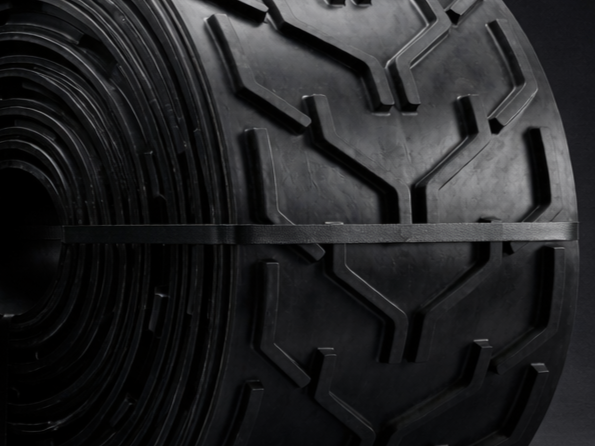
Moventis also provides chevron belts for inclined conveying and sidewall belts for steep or vertical applications. All belts are supplied with full technical documentation and are compatible with standard conveyor system components including drums, pulleys, idlers, and tensioning devices.
Our engineering team supports customers from initial specification through to installation guidance, ensuring the selected belt integrates seamlessly with the overall conveyor system design. We offer flexible quality levels to match performance expectations and budget requirements, backed by proven field experience across mining, aggregate, recycling, and general industry sectors.
Frequently Asked Questions
Moventis supplies EP flat conveyor belts, chevron (profiled) belts for inclined conveying, and sidewall & cleated belts for steep or vertical applications. All belts are available in various strength classes from EP 100 to EP 315, as well as steel cord belts for long-distance, high-capacity systems.
Belt selection depends on several factors: material type and condition, conveying distance, capacity requirements, duty cycle, and environmental conditions. Our Interactive Belt Selector tool on this page can help you identify a suitable belt specification based on your operating parameters.
EP belts use a polyester-nylon carcass and are suitable for short to long distance conveying. Steel cord belts are designed for very long distances (>300 m) and high-capacity applications where low elongation and high tensile strength are critical. Steel cord belts require project-specific engineering.
Cover compounds are selected based on resistance requirements: abrasion-resistant for general conveying, impact-resistant for drop points, cut & tear resistant for sharp materials, oil-resistant for oily environments, heat-resistant for temperatures up to 150°C, and fire-resistant for underground or fire-risk applications.
Minimum drum diameter depends on the belt’s tensile strength and number of plies. Standard EP 125 belts require a minimum of 315 mm, while higher-strength EP 250 belts require at least 400 mm. Our Belt Selector tool provides this recommendation automatically based on your inputs.
Yes. In addition to conveyor belts, Moventis supplies drums & pulleys, idlers & rollers, gear units & motors, and industrial vibrators. We offer both individual components and complete system solutions, ensuring compatibility and long-term consistency across all elements.