
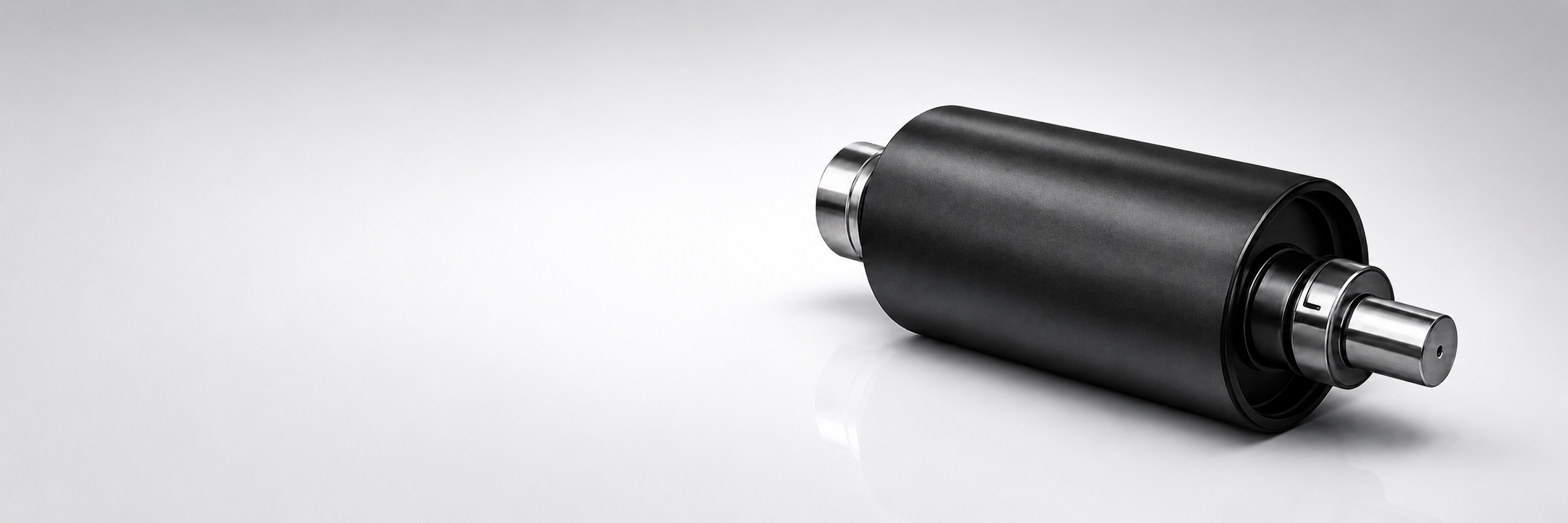
Snub Pulley

Snub Pulley
Snub pulleys are manufactured to improve belt wrap and optimize belt tracking near the drive station. Moventis snub pulleys are designed with compact dimensions, robust shafts, and precise balancing to ensure stable operation and extended belt life.
| Parameter | Available Options / Range | Remarks |
|---|---|---|
| Pulley Type | Snub Pulley | Near drive pulley |
| Pulley Diameter (Ø) | Ø150 – Ø400 mm | Custom diameters available |
| Face Width | According to belt width | Belt width + edge clearance |
| Shaft Diameter (Ø) | Ø30 – Ø120 mm | Selected based on pulley size & belt tension |
| Shaft Type | Solid shaft | Keyed as standard |
| Shaft Material | C45 / AISI 1045 | Higher grades on request |
| Shell Material | Carbon Steel (S235 / S355) | Machined & balanced |
| Pulley Surface Type | Plain | Not lagged |
| Lagging | Not lagged (standard) | Lagging not recommended |
| Bearing Type | Spherical roller bearings | Long service life |
| Bearing Housing | SN / SNL plummer block | Standard |
| Balance Grade | Static / Dynamic | ISO balance standards |
| Design Standard | DIN / ISO | Customer standards possible |
| Operating Temperature | -20 °C to +80 °C | Extended range on request |
| Application Duty | Light / Medium / Heavy duty | — |
About Snub Pulley
Snub pulleys are non-driven deflection pulleys positioned near the drive pulley to increase the belt wrap angle and improve traction at the drive station. The fundamental relationship governing belt drive capacity is the Euler-Eytelwein equation, which shows that the maximum transmittable belt tension ratio increases exponentially with wrap angle. A snub pulley positioned on the slack side of the drive pulley deflects the returning belt downward, increasing the contact arc between the belt and drive pulley from a typical 180° to 210–240°, which substantially increases the available drive force without requiring a larger or more powerful drive unit.
Snub pulleys are smaller in diameter than drive or tail pulleys, which is acceptable because they carry only belt tension loads and no drive torque. However, the minimum diameter must still satisfy the belt carcass bending requirements per DIN/ISO standards. Where the snub pulley is positioned on the return strand, the belt experiences a reverse bend — first bending over the drive pulley in one direction, then bending back over the snub pulley in the opposite direction. Reverse bending is significantly more damaging to the belt carcass than a single bend, and the minimum diameter requirement for reverse-bend positions is correspondingly larger.
Bearing loads on snub pulleys can be surprisingly high. Because the snub pulley deflects the belt through a substantial angle — often 30–60° — the resultant radial load on the shaft is the vector sum of the belt tensions on both sides of the pulley. At high deflection angles, this resultant load approaches the value of the belt tension itself. Despite the small pulley size, the bearing arrangement must be carefully sized for this load to achieve the target service life.
Alignment is critical for snub pulleys. A snub pulley that is not perfectly parallel to the drive pulley will impose lateral forces on the belt, causing tracking problems that may not be immediately apparent but will gradually pull the belt off-centre over multiple revolutions. The snub pulley mounting must allow for precise parallel adjustment, and alignment should be verified after initial installation and rechecked following any maintenance that disturbs the pulley position.
Frequently Asked Questions
A snub pulley is a small-diameter, non-driven pulley positioned close to the drive pulley to increase the belt wrap angle around the drive pulley. The natural wrap angle of a single-drive arrangement is often limited to around 180–190°. By deflecting the belt path with a snub pulley, the wrap angle can be increased to 210–240°, which significantly raises the maximum transmittable drive force without belt slip. Snub pulleys are also used on the return strand to improve belt tracking and tension distribution.
Wrap angle is the arc of belt contact around the drive pulley surface. The maximum belt tension ratio (T1/T2) that can be maintained without slip is determined by the Euler-Eytelwein equation: T1/T2 = e^(μα), where μ is the friction coefficient and α is the wrap angle in radians. Doubling the wrap angle effectively squares the tension ratio capacity. A snub pulley is the most practical way to increase wrap angle in installations where a dual-drive arrangement is not justified.
Snub pulleys carry only the belt tension loads — no drive torque — and are positioned where space near the drive station is limited. A smaller diameter reduces the installation footprint. However, minimum diameter must still comply with the belt carcass requirements per ISO/DIN standards, since the belt bends around the snub pulley at every revolution. The reverse-bend loading imposed by a snub pulley positioned on the return strand is more damaging to the belt carcass than a normal bend, and this must be factored into minimum diameter selection.
Snub pulleys contact the belt on the carrying side (top cover) rather than the carcass or bottom cover. Adding lagging to a snub pulley would increase the friction against the belt’s top cover, causing accelerated surface wear without providing any useful traction benefit. The snub pulley’s function is purely geometric — to redirect the belt path — and a smooth, accurately machined steel surface is sufficient and preferred for this role.
The snub pulley is positioned on the slack-side of the drive pulley — between the drive pulley and the return strand. Its angular position determines the additional wrap angle achieved. The centre distance between the snub and drive pulley, and the snub pulley diameter, together determine the achievable wrap angle. Standard arrangements typically position the snub pulley to achieve a total wrap angle of 200–240°. The snub pulley must be aligned precisely parallel to the drive pulley to avoid introducing lateral belt forces.
Snub pulley bearings carry radial loads from the belt tension on both the incoming and outgoing belt strands. Because the snub pulley deflects the belt through a significant angle, the resultant radial load on the snub pulley shaft can be substantial — often comparable to the belt tension itself at high deflection angles. Bearing selection must account for this combined resultant load, the pulley rotation speed, and the required service life. Despite the smaller pulley diameter, snub pulley bearings should not be under-specified relative to the belt tension.