
Rollers & Idlers

Rollers & Idlers
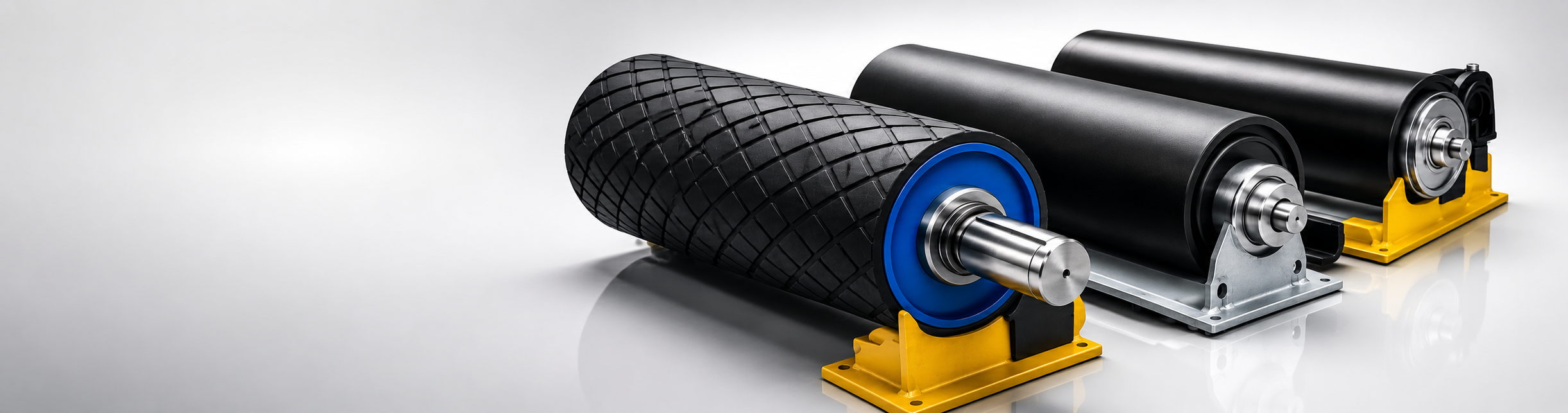
Engineered idler solutions for stable belt support and load carrying, selected according to belt width, material, and operating conditions. Moventis supplies carrying idlers, return idlers, and impact idlers covering belt widths from 400 mm to 1400 mm in standard trough angles of 20°, 30°, 35°, and 45°.
| Parameter | Available Options / Range | Remarks |
|---|---|---|
| Product Group | Carrying idlers (trough/flat) / Return idlers / Impact idlers | Complete idler sets available |
| Belt Width Compatibility | 400 – 1400 mm | Based on belt width |
| Trough Angle | 20° / 30° / 35° / 45° | Application dependent |
| Roller Diameter (Ø) | Ø63 / Ø76 / Ø89 / Ø108 / Ø127 / Ø159 mm | Standard sizes |
| Roller Length | According to belt width | Custom lengths available |
| Shell Material | Carbon steel | Optional rubber coated |
| Shaft Diameter (Ø) | Ø20 – Ø30 mm | Selected by load & roller Ø |
| Bearing Type | Deep groove ball bearings | Heavy-duty options available |
| Sealing System | Labyrinth seal / Contact seal | Dusty/wet environments |
| Surface Options | Plain steel / Rubber ring | Anti-slip |
| Impact Type (Loading Zone) | Rubber ring / impact idler / Impact bed compatible | Drop height dependent |
| Duty Class | Light / Medium / Heavy duty | Based on load & runtime |
| Operating Temperature | -20 °C to +60 °C | Higher range on request |
| Corrosion Protection | Painted / galvanized (optional) | Outdoor & coastal sites |
| Standards | DIN / ISO compatible | Customer standards possible |
About Rollers & Idlers
Carrying idlers form the primary support structure for the loaded belt run. The trough angle — typically 30° or 35° — determines how much material the belt can carry in cross-section. Idler spacing on the carrying run is calculated from the belt mass, material load per metre, and permissible belt sag (1–2% of idler pitch).
Return idlers support the empty belt on the return run at 2.5 to 3 times the carrying idler pitch. In applications where carryback is a problem, rubber-disc return idlers help shed material and prevent belt tracking issues.
Impact idlers are installed in the loading zone to absorb the energy of falling material, protecting both the belt carcass and idler frame. The length of the impact zone depends on drop height and lump size.
Roller sealing is critical in dusty or wet environments. Labyrinth seals provide protection against coarse dust; contact seals add a physical barrier for fine dust or moisture. Double contact seals are used in the most aggressive environments to extend bearing life beyond 30,000 hours.
Frequently Asked Questions
Carry idler spacing is set by limiting belt sag between idlers to 1–2% of the idler pitch under full load. The calculation accounts for belt mass per metre, material load per metre, and belt tension at that point in the system.
30° is the standard choice for most bulk materials. 35° and 45° are used for materials with a low angle of repose where higher capacity cross-sections are needed. 20° is used for stiff belts or where large lumps require greater lateral stability.
Impact idlers are required in the loading zone when drop height exceeds 300 mm for medium materials or 150 mm for large or sharp-edged lumps. The impact zone length is determined by the throw distance of the material stream and lump size.
Labyrinth seals prevent coarse particles from entering bearings via a tortuous path. Contact seals add a physical lip that presses against the rotating element, providing a positive barrier against fine dust and moisture. Double contact seals are used in the most aggressive environments.
Properly selected idlers with L10 bearing life targets above 30,000 hours typically last 3–5 years in medium-duty applications. Key wear mechanisms are bearing contamination (solved by correct sealing), belt overloading (solved by correct spacing and diameter selection), and abrasion of rubber-coated surfaces.
Yes. Moventis supplies idler sets as complete frames including rollers, frame structure, and mounting brackets dimensioned to the customer’s belt width and trough angle. Frames are available in standard steel, hot-dip galvanised, and stainless steel construction.