
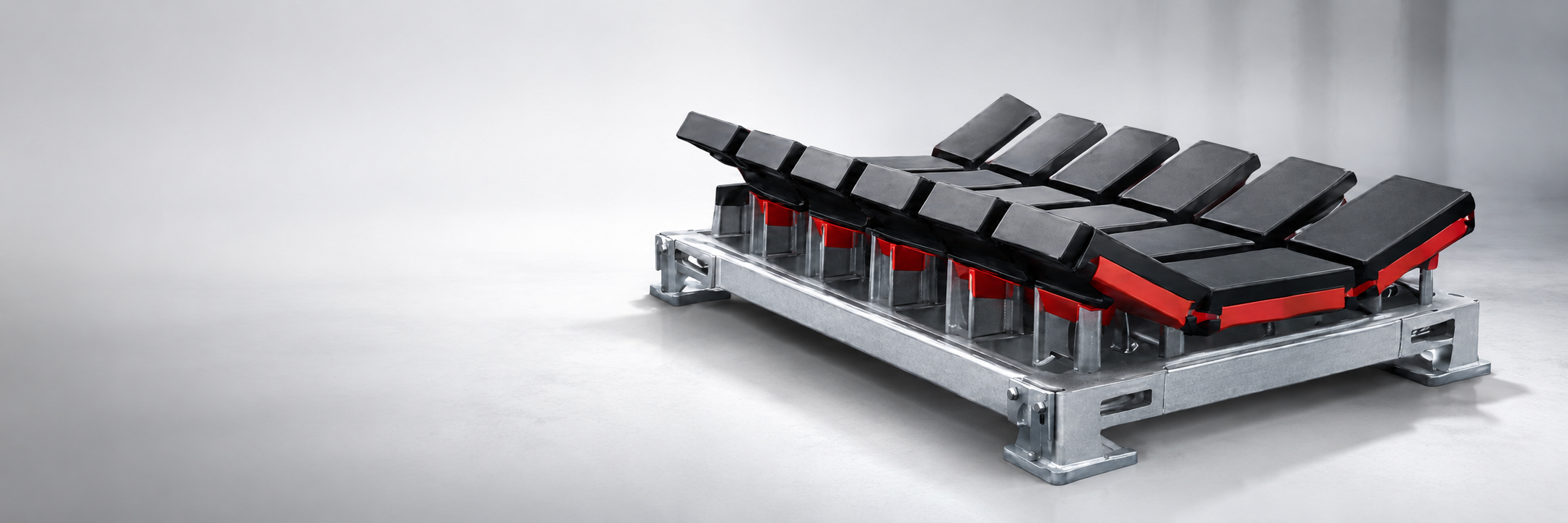
Impact Beds

Impact Beds
Loading zone protection systems designed to absorb impact energy, protect the belt, and reduce material spillage.
| Parameter | Available Options / Range | Remarks |
|---|---|---|
| Product Type | Impact beds / Slider beds | Loading zone applications |
| Belt Width Compatibility | 500 – 2000 mm | According to belt width |
| Bed Length | Short / Medium / Long | Drop height & impact severity dependent |
| Support Type | Impact bars / Slider bars | Energy absorption vs sliding support |
| Bar Cover Material | UHMW-PE | Low friction belt contact |
| Impact Bar Core | Rubber / composite | Shock absorption |
| Frame Construction | Heavy-duty steel frame | Rigid support |
| Mounting Type | Fixed / Adjustable | Alignment & installation |
| Drop Height Suitability | Low / Medium / High | Material impact dependent |
| Material Type | Fine / Bulk / Lump material | Application dependent |
| Operating Environment | Indoor / Outdoor | Dusty & abrasive conditions |
| Duty Class | Light / Medium / Heavy duty | Based on loading severity |
| Maintenance Access | Easy bar replacement | Reduced downtime |
| Compatibility | Rollers, frames, belt systems | Integrated conveyor design |
About Impact Beds
Impact beds are installed in the loading zone — the area where material falls from a chute or transfer point onto the moving belt. This is the highest-stress zone in any conveyor system: the belt is simultaneously subjected to the full weight of the falling material, the dynamic shock of impact, and the lateral spreading force of the material stream.
Impact bars are the primary load-bearing element of the impact bed. They consist of a UHMW-PE wearing face bonded to a rubber core. The UHMW-PE provides low sliding friction against the belt backing, minimising drag and heat generation. The rubber core absorbs the kinetic energy of the falling material, reducing peak stress transmitted to the belt carcass and idler frames.
Slider beds are used in applications where continuous belt support between idlers is required — typically when fine or sticky materials would otherwise cause the belt to sag between widely spaced idlers, leading to spillage. They use full-length UHMW-PE bars without an impact core and are suited to lighter duty loading zones.
Bed length is determined by the throw distance of the material stream and the height of the transfer point. Longer drop heights increase the throw distance and require longer impact beds to fully capture the material before it reaches the first standard idler. Heavy-duty applications with large lump material or high drop heights may require additional reinforcement of the bed frame and closer mounting point spacing.
Frequently Asked Questions
Bed length is set by the throw distance of the material stream from the transfer chute, which is a function of drop height, belt speed, and material particle size. As a general rule, the impact zone should extend at least 1.5× the horizontal throw distance beyond the chute outlet. Heavy-duty applications with large lumps or high drop heights require longer beds.
Impact bars have a UHMW-PE wearing face over a rubber shock-absorbing core, designed to absorb kinetic energy from falling material. Slider bars use UHMW-PE throughout without a rubber core — they provide continuous belt support and low-friction sliding contact but offer no shock absorption. Impact bars are used in the high-drop zone; slider bars extend the supported zone beyond it.
UHMW-PE (Ultra-High Molecular Weight Polyethylene) has a very low coefficient of friction against conveyor belt backing rubber — typically 0.05–0.15 — which minimises drag, heat generation, and belt wear. It is also highly resistant to abrasion, impact, and most chemicals, giving long service life in aggressive loading zone environments.
Bar life depends on belt speed, material abrasiveness, and loading rate. In medium-duty applications with moderately abrasive material, impact bars typically last 6–18 months. The bar design allows individual bars to be replaced without removing the frame, reducing downtime. Worn bars should be replaced before the rubber core contacts the belt, which would cause rapid belt damage.
Impact beds are compatible with standard rubber-backed conveyor belts. They should not be used with PVC-backed or fabric-topped belts without verifying friction compatibility. The belt tension must be sufficient to maintain contact with the bars across the full bed width — insufficient tension causes the belt to lift off the bars under impact, reducing protection effectiveness.
Impact beds are mounted to the conveyor stringers using adjustable clamp or bolted brackets. The mounting must be rigid enough to resist the lateral and vertical forces from the material stream without deflection. Adjustable mounting allows the bed to be centred under the chute discharge point and levelled to match the carrying idler line.