
Belt Cleaners & Ploughs

Belt Cleaners & Ploughs
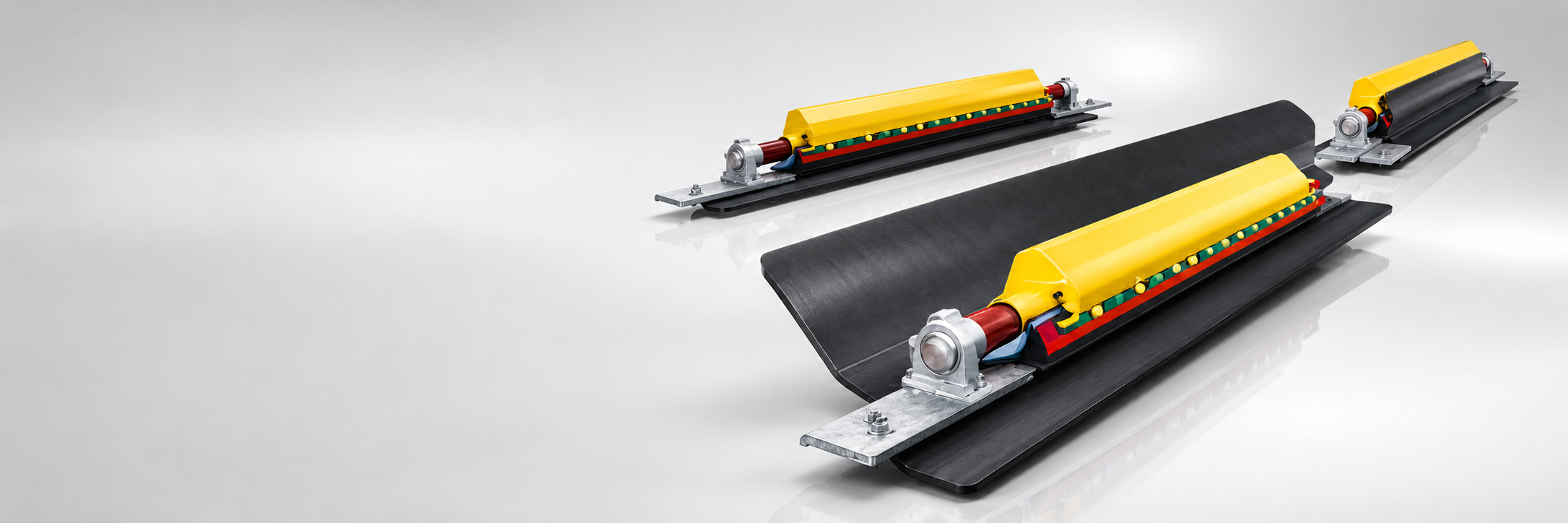
Belt cleaning and protection solutions designed to reduce carryback, protect components, and improve conveyor reliability.
| Parameter | Available Options / Range | Remarks |
|---|---|---|
| Product Group | Belt cleaners / Return ploughs | Carryback control |
| Cleaner Type | Primary cleaner / Secondary cleaner | Head pulley area |
| Plough Type | V-plough / Diagonal plough | Return belt protection |
| Belt Width Compatibility | 400 – 2000 mm | According to belt width |
| Blade Material | Polyurethane / Carbide (optional) | Material abrasiveness dependent |
| Mounting Location | Head pulley / Return belt | Application dependent |
| Adjustment Type | Manual / Spring-loaded | Consistent blade contact |
| Operating Speed | Low to high belt speeds | Belt speed dependent |
| Material Condition | Dry / Wet / Sticky material | Carryback severity |
| Frame Construction | Carbon steel | Rigid mounting |
| Maintenance Requirement | Easy blade replacement | Reduced downtime |
| Operating Environment | Indoor / Outdoor | Dusty & abrasive sites |
| Duty Class | Light / Medium / Heavy duty | Runtime dependent |
| Design Standards | DIN / ISO compatible | Customer standards possible |
About Belt Cleaners & Ploughs
Primary belt cleaners are mounted on the head pulley discharge face, making contact with the belt as it wraps around the drive drum. This is the most effective position for removing the bulk of carryback — material that adheres to the belt surface after discharge. Primary cleaners use a tungsten carbide or polyurethane blade held in tension or spring-loaded contact against the belt at a specific scrape angle, typically 30–45° to the belt travel direction.
Secondary cleaners are positioned on the return strand of the belt, typically 0.5–1.5 m after the head pulley. They remove the fine residual layer of material that passes the primary cleaner. Secondary cleaners use multiple segments or a matrix blade design to conform to belt surface variations and maintain consistent contact pressure across the full belt width.
Ploughs are mounted on the return belt strand upstream of the tail pulley or any return idler. Their purpose is to deflect material that has fallen onto the return belt — carryback that was not removed by the cleaners — away from the tail pulley, preventing material build-up and belt tracking problems. V-ploughs deflect material to both sides; diagonal ploughs deflect to one side only.
Blade tension and contact pressure must be set correctly for each application. Under-tensioned blades lose contact with the belt surface and fail to clean effectively. Over-tensioned blades accelerate both blade and belt wear, generate heat, and increase drive power consumption. Spring-loaded and pneumatic tensioning systems maintain consistent contact pressure as the blade wears, reducing maintenance intervals and extending blade life.
Frequently Asked Questions
A primary cleaner is mounted at the head pulley discharge face and removes the bulk of carryback before the belt enters the return strand. A secondary cleaner is positioned on the return strand after the head pulley and removes the fine residual layer left by the primary. Most medium to heavy-duty applications require both primary and secondary cleaners to achieve acceptable belt cleanliness.
Tungsten carbide blades offer the longest service life in abrasive applications but must be used on belts with sound surface condition — they can damage worn or spliced belt surfaces. Polyurethane blades are softer and more forgiving, suited to belts with mechanical splices, worn covers, or more delicate belt constructions. Ceramic-tipped blades are used in very high abrasion environments.
Contact pressure is set by the tensioning system — spring, pneumatic, or gravity-weighted. The correct pressure is the minimum needed to maintain effective cleaning contact across the full blade width. Too little pressure allows the blade to lift off the belt surface; too much accelerates wear on both the blade and belt cover. Manufacturer guidelines typically specify a contact force per unit blade width (N/mm).
A plough is required when carryback material is present on the return belt strand upstream of the tail pulley or any return idler. Even with effective primary and secondary cleaners, some residual carryback will remain in wet, sticky, or fine material applications. Without a plough, this material accumulates on the tail pulley and return idlers, causing belt mis-tracking and structural damage.
Blade life depends on belt speed, material abrasiveness, and moisture content. Tungsten carbide blades typically last 6–18 months in medium-duty applications. Polyurethane blades may need replacement every 2–6 months depending on conditions. Automatic or spring-loaded tensioning systems extend effective blade life by maintaining contact pressure as the blade wears down.
Belt cleaners can be fitted to most conveyor types, but installation requires sufficient space at the head pulley for the cleaner mounting structure and blade access. Very short conveyors with limited tail-to-head distance may restrict secondary cleaner placement. High-angle conveyors may require modified cleaner geometry to account for the belt contact angle at the head pulley.